
Decisions in Milliseconds
In high-stakes environments, success often depends on decisions that take less than a second to make: a slight adjustment to a propeller, a correction to a flight path, a split-second response to changing conditions. Made in milliseconds, these decisions collectively influence mission outcomes, emergency response efforts, and ultimately, human safety.
“You don’t necessarily need to know how the situation is going to evolve over the next two hours. If there’s smoke coming at you, you just need to know where it’s going to go in the next five seconds so you can avoid it.”
Building Trust in Autonomous Systems
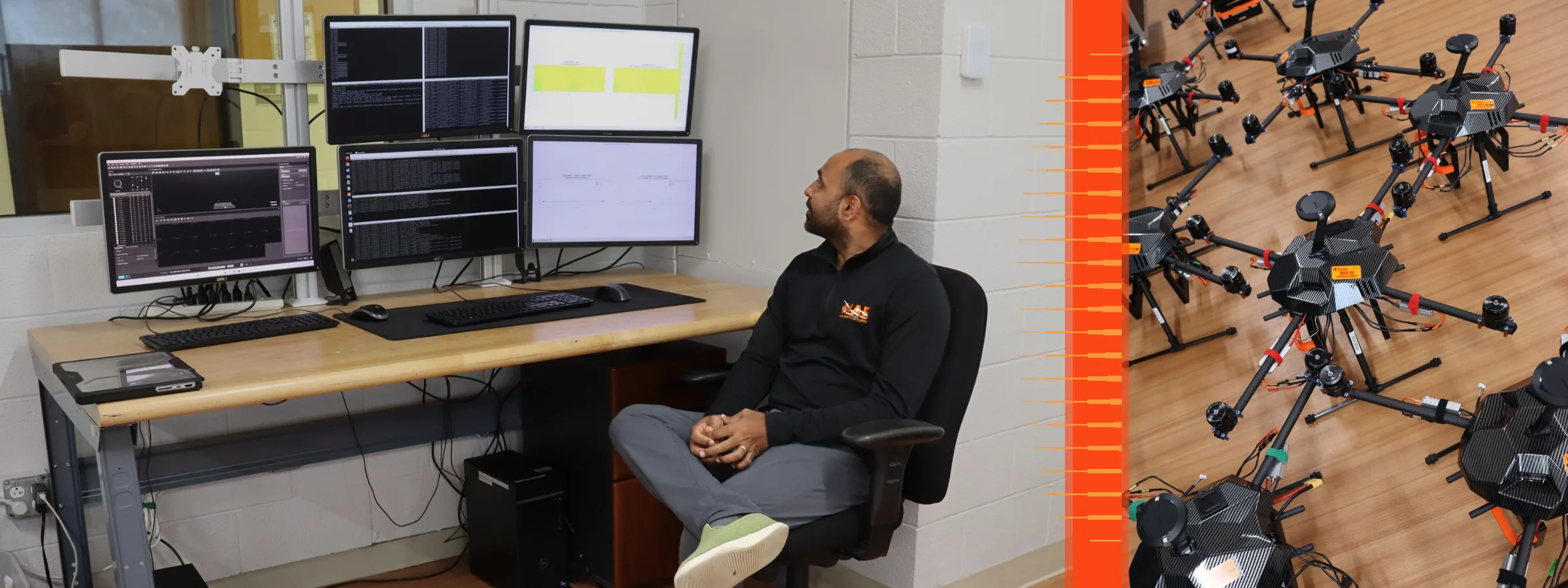
Teaching autonomous systems to make reliable decisions with limited information is the work of Rushikesh “Rushi” Kamalapurkar, Ph.D. and his team in the University of Florida’s Systems, Cognition, and Control Laboratory. Central to his work is control theory, a field that focuses on understanding and guaranteeing how autonomous systems will behave when faced with changing conditions.
Consider an autonomous drone flying through a search and-rescue mission. While the overall goal may be to locate survivors, the drone is constantly making thousands of smaller decisions at different levels. At the lowest level, the drone must react almost instantly to disturbances in its environment. A gust of wind, a shifting payload, or a sensor error can alter its flight path. Every few milliseconds, onboard algorithms determine how fast individual propellers should spin to keep the aircraft stable and on course. A second layer of decision-making focuses on navigation. If the drone needs to pass through a window or enter a damaged building, it must determine the next waypoint along its route. Every second, the vehicle evaluates where it is, where it needs to go, and whether its lower level control systems can successfully execute that plan. Knowing how accurately a vehicle can follow those commands is critical.
“Does the algorithm compensate for these changes, and if so, how much can it compensate for? If you know how well the lower-level controls perform, then you can make better decisions about planning.” Kamalapurkar said.
Much of his research focuses on developing mathematical guarantees for these systems, determining the conditions under which aerial drones, underwater vehicles, and ground robots can operate reliably and the level of uncertainty they can tolerate while maintaining performance.
Coordinated Intelligence
Today, most of Kamalapurkar’s lab focuses on these lower-level control problems, but he sees the future of autonomy moving toward a higher level of decision making, where multiple robots work together to solve complex challenges. Imagine a team of autonomous vehicles equipped with sensors that measure chemical concentrations in the air after an industrial accident, wildfire, or hazardous materials spill. Instead of operating independently, the vehicles could communicate with one another, share information, and build a real-time map showing which areas are safe and which should be avoided.
“How do those robots work together to create that map?” Kamalapurkar said. “That’s the kind of problem we’re interested in solving over the next five to ten years.”
Such systems could one day help first responders make faster, more informed decisions during emergencies, identifying dangerous areas before humans enter them. Kamalapurkar’s research is supported by organizations including the Air Force Research Laboratory and, previously, the Office of Naval Research, reflecting growing interest in autonomous systems that can operate reliably in complex environments.
The Role of Mentorship
In the lab, graduate students play a central role by developing algorithms, running simulations, and testing new ideas using software platforms. As students advance through their doctoral studies, they increasingly develop their own research directions, building on the foundational problems explored in the lab. Kamalapurkar takes great pride in preparing the next generation of engineers and researchers to tackle the challenges that lie ahead. He sees their growth as the most meaningful measure of success. Whether the challenge involves stabilizing a drone in strong winds, guiding an underwater vehicle through changing tides, or guiding a land drone into unknown conditions, Kamalapurkar’s work centers on the common goal of creating autonomous systems that can make reliable decisions in ever changing environments.
“The happiest days for me are when one of my students walks into a meeting and teaches me something new. Watching their journey from not knowing what they are doing to knowing more about their dissertation topics than I ever can is fascinating to me.”