
Portable device delivers rapid testing for mosquito-borne viruses

With a lot of ingenuity, some creative engineering and a few off-the-shelf items, a University of Florida team led by a virologist and an engineer have created an inexpensive, quick and accurate handheld device that can detect seven mosquito-borne illnesses. Their design could help clinicians in low-resource or remote settings — from clinics in rural Haiti…
UF-ITAC Named 2026 U.S. Department of Energy Center of the Year

Recognition for Excellence The University of Florida Industrial Training and Assessment Center (UF-ITAC), housed in the Department of Mechanical and Aerospace Engineering, and directed by S.A. Sherif, Ph.D., has been named the 2026 U.S. Department of Energy Industrial Training and Assessment Center of the Year, the highest recognition awarded among ITACs nationwide. The Center of the…
UF researchers uncover surprising boiling behavior in liquids that could advance future space missions
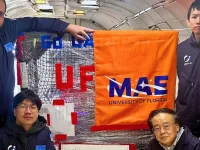
When astronauts travel deeper into space, every drop of fuel becomes critical, and keeping those fuels stable for months or even years is one of the biggest engineering challenges facing future missions. Now, University of Florida researchers have uncovered a surprising behavior in boiling liquids that could help solve that challenge. The findings, published July 8…
Department of Energy Genesis Mission grant to UF-led team will speed up development of stronger materials

A cross-disciplinary research team led by the University of Florida won a prestigious federal grant on Wednesday to develop an autonomous artificial intelligence platform that could fundamentally change how new materials are discovered. Selected from more than 5,000 applications, the project is one of 278 chosen under the U.S. Department of Energy’s highly competitive Genesis Mission Request for…
UF researchers develop AI tool to guide young engineers
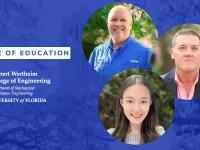
Year after year, engineering students at the University of Florida face a similar challenge: internships can shape their future, but they’re unsure of which opportunities will match their goals, abilities and emerging sense of self as engineers. A new artificial intelligence system, developed by UF researchers, aims to make the decision easier. Pro-CaRE, created by a…
Reaching Beyond the Possible: Dr. Hitomi Greenslet’s Approach to Manufacturing and Mentorship
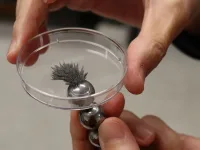
Looking Beyond the Surface Some engineering problems are easy to see. Others remain hidden deep within rocket engines, medical devices, and components so small that conventional tools cannot physically reach them. Those invisible challenges are exactly what fascinates Hitomi Yamaguchi Greenslet, Ph.D. “If I ask you to put your finger inside a hypodermic needle, you can’t…
MAE Capstone Experiences

Mechanical Engineering Experience If you are an engineer, there is a good chance that you still remember your Capstone project. Capstone is the culminating experience of an undergraduate engineer’s time in MAE – it is an opportunity for students to combine all of the practical and theoretical knowledge that they have accumulated to create a prototype…
UF partnership brings robotic fish to Florida classrooms to spark young scientists
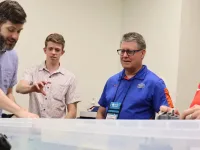
Elementary school students across Florida are using robotic fish to learn one of science’s most fundamental skills: asking questions. A partnership between the University of Florida Department of Mechanical and Aerospace Engineering and the Thompson Earth Systems Institute at the Florida Museum of Natural History is developing hands-on classroom kits that help students investigate scientific concepts through experimentation…
Yu Wang’s Vision for Safer, More Human-Centered Autonomous Systems

For Yu Wang, Ph.D., engineering has always been about more than technology. It’s about people. Long before receiving one of the nation’s most prestigious honors for early-career faculty, the National Science Foundation CAREER Award, Wang was fascinated by a simple question: How can we teach autonomous systems to be safer, more reliable, and more beneficial to…
Drones and decisions: UF optimizing communication among autonomous units

Imagine a cluster of drones swarming above a dense thicket of trees, eyeing its way through unfamiliar topography to locate a missing person amid unpredictable weather. Each drone has its own complex communication and computing capabilities. But as that weather starts to sour against the clock, the rescue mission requires group optimization, not a single drone…