

Mechanical Engineering Experience
If you are an engineer, there is a good chance that you still remember your Capstone project. Capstone is the culminating experience of an undergraduate engineer’s time in MAE – it is an opportunity for students to combine all of the practical and theoretical knowledge that they have accumulated to create a prototype product. Working in teams, senior engineering students are paired with a client and presented with a customer needs statement, which outlines all features their design must include. Beyond those guidelines, students have the freedom to innovate, choosing features that enhance and refine their creations.
The Capstone courses are not mere classes. In senior design, each individual advances from an apprentice to a practicing engineer; this transformation happens under the supervision of expert faculty who bring real-world industry experience. Students face common obstacles in applying theoretical concepts, particularly when translating digital models into physical, functional hardware. By the end of the sequence, they have demonstrated tangible examples of their expertise. This evidence can be leveraged in interviews with potential employers, or as the seed of a student-founded startup company – ME Capstone has produced four such startups in the past three years.
Inside EML4501
The ME Capstone sequence begins with EML4501 – Mechanical Engineering Design 2, led by Dr. Umesh Persad. Each section of the class is paired with a client who presents a real, unsolved engineering problem. Students work in teams to create a conceptual design using computer-aided design (CAD) software and 3D-print key mechanisms to test that their ideas work.
By the end of the semester, student teams aim for a proposed design that reaches Technology Readiness Level (TRL) 3. The TRL scale, used by NASA, the U.S. Military, and companies, measures how developed a technology is, from 1 (just an idea) to 9 (a fully built, commercial-ready product). Reaching TRL 3 means the students’ designs are functional on paper and in early testing. Teams present their work to the client and a panel of experts through design reviews and a written report.
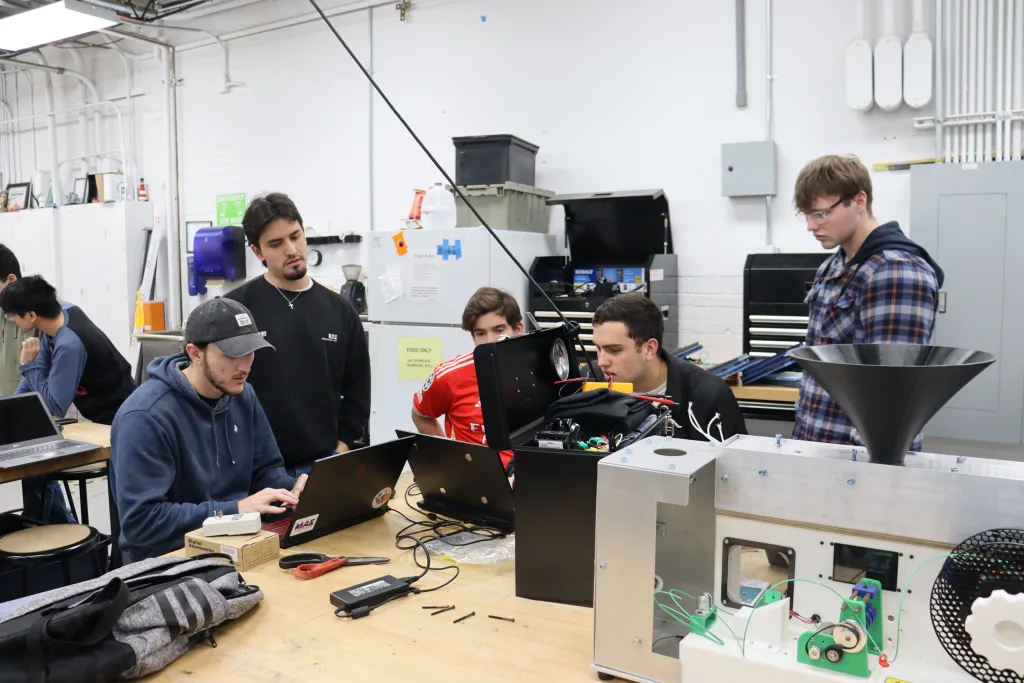
In the following semester, students take EML4502 – Mechanical Engineering Design 3. This course is the final step in the Capstone sequence before graduation, and for many, it is the launchpad for their career. Taught by Dr. Matthew J. Traum, EML4502 takes students through the technical aspects of engineering product design – how to translate drawings and theory to a functional prototype on the lab bench.
Students select groups based on project preference; some continue with their EML4501 projects from the previous semester while others undertake projects new to them.
A Partnership with IFAS
One such project in the ongoing pipeline is an interdisciplinary collaboration between UF MAE and IFAS. In EML4501, student teams worked to design an automated soil sampling system for Dr. Franta Majs. Majs is the Director of the IFAS Analytical Services Laboratories (ANSERV Labs), an agricultural science research group that serves the entire state of Florida.
The territory of Florida, though seemingly flat and plain, is geologically diverse. This variability presents a challenge to soil scientists at UF IFAS, who are responsible for gathering data on the characteristics and quality of soil from across the state – amassing and testing more than 300,000 samples per year. Moreover, the soil must be retested annually, as changing climate conditions impact soil quality. These measurements are crucial to Florida’s agricultural industry.
Currently, these samples are manually collected, measured, and tested; an expensive and labor-intensive process. The samples must be weighed to very precise masses to ensure uniformity and accuracy in the subsequent quality evaluations. In addition, the complex soil makeup of Florida requires careful differentiation between soil classes to ensure proper tests are assigned to the samples. Due to the large volume of samples processed every year, it is easy to get lost between bags of dirt – therefore, soil samples must be labeled and stored carefully.
Designing Smart Soil Systems
Last spring, EML4501 students designed robots capable of taking samples of accurate mass, categorizing them, and transporting them between test vessels. Such a machine will vastly reduce the labor required for this procedure and improve accuracy by automating repetitive steps. The machines were required to separate mineral-based from organic-rich soil samples and to transfer precise masses of material from sample bags into extraction vessels. On top of these requirements, students were challenged to stay within a strict budget to ensure their machines were a reasonable investment for IFAS and other agricultural research institutions.
Two teams carried their designs forward to EML4502. Having previously printed the critical components of their machines to verify functionality, these students must now produce the entire machine. However, integrating all parts into a complete assembly affects the performance of each individual component, as everything must fit and work together seamlessly. Students are refining their designs to optimize the machine and collaborating closely as they navigate the challenges that arise throughout the process. They are also preparing to present their fleshed-out designs in front of the client, industry sponsors, faculty, and stakeholders. The audience will have varying degrees of engineering background, requiring students to communicate technical information in a digestible way. By the end of the sequence, students demonstrate mastery of the broad range of competencies required in a professional engineering design environment.
Capstone As a Career Catalyst
Capstone is more than a class project — it represents the culmination of the knowledge, collaboration, and problem-solving skills that engineering students have developed throughout their undergraduate studies. By addressing real-world challenges, students strengthen their technical expertise as well as their capacity for communication, project management, and teamwork — all essential for success in a professional environment. ME Capstone students emerge not just as graduates, but as engineers ready to tackle the complex problems of tomorrow.
AE Capstone Students Take CubeSat Designs to International Conference
The aerospace engineering program at MAE is a rich curriculum that offers students more than an education: students get experience building relevant technology by working in a semi-professional setting. By the end of the course, students are able to specialize depending on their interests.
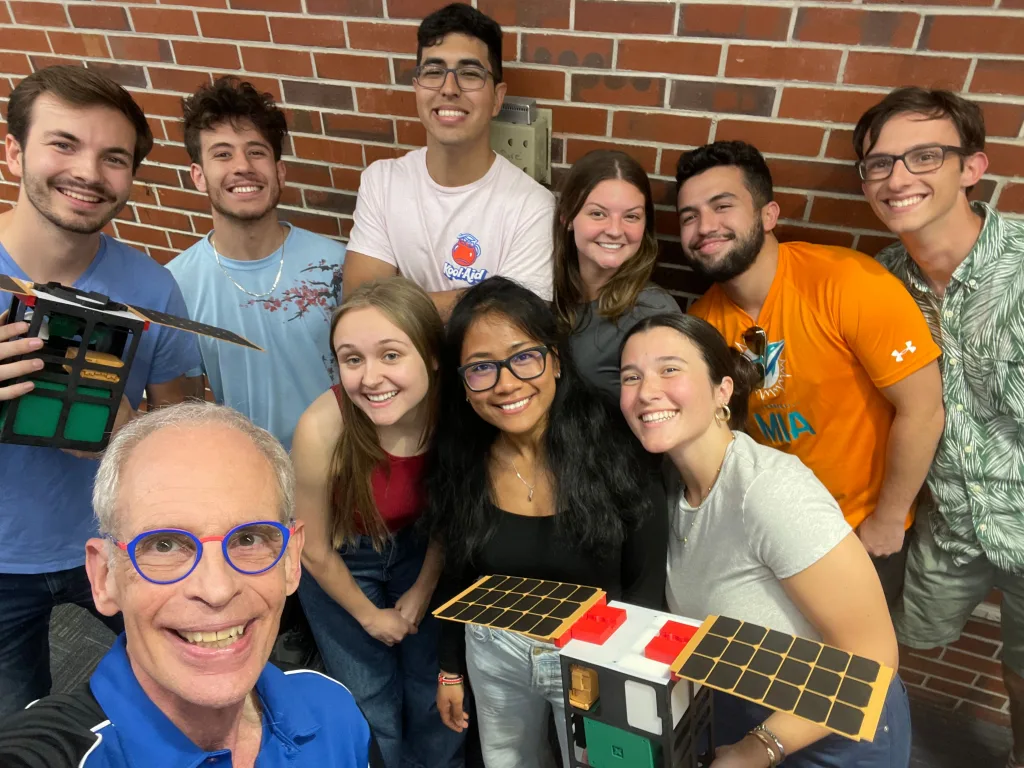
The astronautics Capstone course (EAS4700) is taught by Ting Dong, Ph.D., and Mike Generale , M.Eng. Last year, astronautics Capstone students worked on CubeSats – a class of small spacecraft that built using standard cubic units (“U”) for size and structure. CubeSats can support a wide range of missions, from communications to space weather monitoring, and are often deployed as secondary payloads alongside larger missions.
Traditionally, CubeSats are built using off-the-shelf components and can be prepared for launch on a much shorter timeline than conventional spacecraft. This gives them a significant advantage in terms of cost, speed, and flexibility. Their accessibility has opened up the field of astronautical engineering to students, smaller institutions, and public organizations.
This presented an exciting opportunity for Capstone students. Working in teams of six to ten, they spent the semester designing their own CubeSats based on the requirements set by the instructor. Rather than focusing on new material, the course emphasized applying their cumulative undergraduate knowledge to a real-world engineering challenge. Students also developed key professional skills – collaborating to manage deadlines, preparing formal presentations, and delivering concise elevator pitches to communicate their designs effectively.
Two student groups went on to pitch their designs at the 39th Annual Small Satellite Conference in early August – one of the most influential events in spacecraft research. This year’s conference attracted nearly 5,000 attendees from 48 countries, giving students the chance to connect with potential employers, academic peers, and learn from global engineering leaders.

The graduate team presented their project during one of the speaking sessions. Comprised of Tabitha Patrick, Allen Martinez, Aimee Dew, and Shane Hancock, the group discussed their CubeSat “Icarus” – a 27U satellite designed to operate at Sun-Earth Lagrange Point 5 (L5) to collect data on solar weather. They also presented Icarus as a proof-of-concept on long-duration CubeSat operations in deep space.
The second team tackled the issue of In-Space Servicing, Assembly, and Manufacturing (ISAM) with a dual robotic arm system adapted for CubeSats. The design features small, low-cost arms capable of repairing and repositioning satellites autonomously. This is an especially relevant project, as CubeSats have become more popular for use in long-duration missions, requiring maintenance from space.
This team included Jonathan Tindall, Michael Daher, Arin Churi, Jake Piccirillo, Anais Mera-Sarnelli, George Serra, Zach Merly, Andrew Dishchuk, Michael Madden, and Christian Szczezniak.
These student-led projects highlight the strength of MAE’s hands-on, project-based approach to aerospace education. By working on real-world engineering challenges, students gain not only technical expertise, but also the confidence and experience needed to thrive in the aerospace industry.