
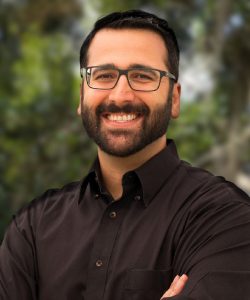

Professor Angelini received his Ph.D. in 2005 from the University of Illinois. His research interests include collective cell motion, mechanical instabilities in tissue cell assemblies, bacterial biofilm physics, soft matter physics, biomolecular self-assembly, and tribology of soft matter interfaces.
Education
Ph.D., 2005, University of Illinois
Professional Memberships and Fellowships
American Physical Society, Member
Society of Tribologist and Lubrication Engineers, Member
Teaching Interests
Soft Biological Mechanics, Soft Tissue Mechanics, Data Measurement and Analysis, Vibrations.
Research Interests
Collective cell motion, mechanical instabilities in tissue cell assemblies, bacterial biofilm physics, soft matter physics, biomolecular self-assembly, and tribology of soft matter interfaces.

Professor Banks has been active in orthopaedic and joint mechanics research his entire career. He is a member of several professional societies including ASME, the Knee Society, the American Society for Biomechanics and the Orthopaedic Research Society. Professor Banks served as President and annual conference host for the International Society for Technology in Arthroplasty in 2013, and remains a member of the Board of Directors. Professor Banks holds numerous medical device patents, works with several medical device companies, and has designed joint replacement implants that have been used in over 100,000 patients.
Education
Ph.D., 1992, Massachusetts Institute of Technology
M.Sc., 1988, B.Sc., 1985, Case Western Reserve University
Teaching Interests
Musculoskeletal biomechanics, measurement techniques and technologies, robotics and controls.
Research Interests
Biomechanics of human and animal joints in healthy, injured and replaced states. Techniques and technologies for quantifying musculoskeletal biomechanics. Musculoskeletal modeling for surgical planning and treatment design. Medical robotics for surgery and research.
SELECTED PUBLICATIONS

Professor Bevilacqua holds a M. Sc. in Aerospace Engineering (2002), and a Ph. D. in Applied Mathematics (2007), both from the University of Rome, “Sapienza”, Italy.
Education
Ph.D., 2007, Sapienza University, Rome, Italy
Teaching Interests
Dynamics, Control, Spacecraft Mechanics.
Research Interests
His research interests focus on spacecraft formation flight, space robotics, small spacecraft, and spacecraft-atmosphere interaction.

Education
H.D.R.(Habilitation a Diriger les Recherches), 2004, University of Lille, France D.S., 1995, University of Lille, France,
Professional Memberships and Fellowships
American Society of Mechanical Engineers, Member
Research Interests
Damage, Metal Plasticity and Viscoplasticity, Rock and Soil Mechanics, Mechanics of Particulate Materials, Penetration Mechanics

Mr. Michael Generale is a seasoned professional with over thirty years of experience in the Aerospace industry. He was intimately involved in developing and operating aerospace vehicles with the United States Air Force and the National Aeronautics and Space Administration.
He was a Contracting Officer Technical Representative with the United States Air Force on the Small ICBM, Peacekeeper ICBM, and Titan IV space launcher programs. He oversaw the development, production, and fielding of Air Force launch vehicles.
He spent 28 years with NASA as a Space Shuttle Orbiter Operations Engineer, Space Shuttle and International Space Station Payloads Processing and Operations Engineer, International Space Station Payloads Test Director, Orion Program Test Director, and Orion Recovery Operations Manager. He has extensive experience developing, testing, integrating, and operating spaceflight hardware and related equipment. He led the team that recovered the first flight Orion space capsule on the EFT-1 mission in 2016.
Mr. Generale’s leadership skills have been honed through extensive experience leading large, multi-organizational, blended government and contractor teams. Under his guidance, these teams have successfully performed test and flight operations of spaceflight and support hardware during dynamic, time-critical, and high-profile mission activities.
Since 2020, Mr. Generale has shared his wealth of knowledge and experience as an adjunct professor at the University of Florida. His Capstone course in Aerospace Design, which he teaches with great passion, equips graduating seniors with the skills necessary to excel in their own careers in the Aerospace industry. He takes great pride in guiding groups of students, who start as relative strangers, to become high-functioning teams in the course of a few weeks.
education
- 1993 – Master of Science degree in Engineering/Industrial Management from the University of Central Florida
- 1985 – Bachelor of Science degree in Aerospace Engineering from the University of Florida
notable awards
- The Air Force Office of the Inspector General recognized him as a key player and innovator in effectively developing and fielding USAF launch vehicles (1986).
- He earned the NASA Silver Achievement Medal for his leadership in developing the procedures and hardware used in the Orion Underway Recovery Test #1 (2013).

Dan Guralnik received his Ph.D. from the Technion-IIT Mathematics department in 2005, specializing in Geometric Group Theory. After post-doctoral appointments at Vanderbilt University and University of Oklahoma, where he worked on asymptotic geometry and boundary dynamics of discrete groups, he moved in 2011 to a post-doctoral appointment at KodLab, the legged locomotion laboratory at the University of Pennsylvania, to start work on applications of topology and category theory to problems of knowledge representation in the context of navigation and control. In fall 2019 he has joined NCR as a research scientist to work on developing formal and category-theoretical methods in hybrid control, as part of the AFOSR Center of Excellence in Assured Autonomy in Contested Environments.
Education
Ph.D. Mathematics (Technion-IIT)
Professional Memberships and Fellowships
American Mathematical Society, Member
Teaching Interests
Algebra (linear, group theory, commutative algebra), Analysis/Calculus, Topology (point-set and algebraic), topics courses on connection of algebra and topology in control.
Research Interests
Hybrid dynamical systems theory from a category-theoretic viewpoint; mobile agent networks; general artificial intelligence and learning from the point of view of internal representations; finite metric geometry and quantization (e.g. clustering); geometric group theory and its applications; asymptotic invariants of non-positively curved groups and continua theory.

Matthew Hale received his BSE summa cum laude from the University of Pennsylvania and received his MS and PhD from Georgia Tech. His work is driven by designing and analyzing multi-agent coordination algorithms that function well under challenging conditions, such as asynchronous information sharing, noisy communications, and user privacy requirements. His work deploys these algorithms on teams of flying and ground robots, providing both validation of the underlying theory and further research directions. He was named the MAE Department’s Teacher of the Year for 2018-2019 and received an NSF CAREER Award in 2020.
Education
Ph.D., 2017, Georgia Institute of Technology
Professional Memberships and Fellowships
American Institute of Aeronautics and Astronautics, Member
The American Society of Mechanical Engineers, Member
Institute of Electrical and Electronics Engineers, Member
Sigma Xi, Member
Teaching Interests
Network control systems, Optimal control, Classical control
Research Interests
Multi-agent learning and control, Privacy, Optimization, Robotics

Ryan Houim received his BSME from North Dakota State University and his MS and Ph.D. degrees from the Pennsylvania State University. He was a National Research Council post-doctoral fellow at the Naval Research Laboratory and a Research Assistant Professor at the University of Maryland prior to joining the University of Florida. His research is focused on understanding the dynamics of multiphase and chemically reactive flows using numerical simulation techniques. Applications of this work include dust explosions, detonation initiation, detonation engines, and the combustion of solid propellants and metal particles.
Education
Ph.D., 2011, The Pennsylvania State University
Professional Memberships and Fellowships
American Institute of Aeronautics and Astronautics, Member
American Physical Society, Member
Teaching Interests
Fluid mechanics, combustion, heat transfer, thermodynamics, computational fluid dynamics
Research Interests
Combustion and multiphase flows including detonation initiation and propagation, dust explosions, propulsion, spray combustion, solid propellant and metal particle combustion.


Dr. James Klausner is an MSU Foundation Professor and Mechanical Engineering Department Chair at Michigan State University (2016-present). He formerly served as Chair of the ASME Heat Transfer Division (2011-2012). He serves on the board of directors for the American Society of Thermal Fluid Engineers and the International Titanium Association Foundation. For three and a half years he served as a Program Director at the U.S. Department of Energy Advanced Research Projects Agency-Energy (ARPA-E). Prior to that he held the Newton C. Ebaugh Professorship in Mechanical and Aerospace Engineering at the University of Florida (1989-2015). He received his Ph.D. degree in 1989 from the University of Illinois, Urbana-Champaign. He has made substantial fundamental contributions to understanding the dynamics of boiling heat transfer systems. He has made many fundamental and applied research contributions in high temperature thermochemistry, waste heat and solar driven desalination, and high heat flux phase-change heat transfer. Dr. Klausner has authored more than 150 refereed publications, and his theoretical work on boiling dynamics is included in the Handbook of Heat Transfer. He is the author of ten patents and four provisional patents. He is a Fellow of the American Society of Mechanical Engineering and the American Society of Thermal Fluid Engineers. He is a recipient of the ASME Heat Transfer Division Memorial Award and the 75th Anniversary Award.

Dr. William. E. Lear is an Associate Fellow of AIAA, recipient of the 2014 Energy Systems Award from AIAA, former Chair of the Terrestrial Energy Systems technical committee, and has served in multiple roles with the International Energy Conversion Engineering Conference, including Technical Program Chair. His areas of research are novel distributed generation systems, advanced turbomachinery, and low temperature fuel cells. He is co-inventor of the Power, Water Extraction, and Refrigeration system, a novel gas turbine-absorption refrigeration combined cycle, as well as several inventions in the area of direct methanol fuel cells.
Education
Ph.D., 1984, Stanford University
Teaching Interests
Thermal sciences, including gas turbine and fuel cell systems and the fundamental thermal sciences.
Research Interests
Novel distributed generation systems, advanced turbomachinery, and low temperature fuel cells; combustion, especially Flameless combustion; transport processes


Gary J. Miller is co-founder and served as Vice President/Executive Vice President for Research and Development of Exactech, Inc., Gainesville, Florida. Exactech was incorporated in 1985 to develop, manufacture and distribute orthopaedic medical devices. He retired from the company in 2020.
Gary received his Bachelor of Science Degree in Mechanical Engineering in 1970 from the University of Florida, Master of Science in Mechanical Engineering (Biomechanics) from MIT in 1972 and Ph.D. in Mechanical Engineering (Biomechanics and Biomaterials emphasis) in 1977 from the University of Florida. A Proud DOUBLE GATOR!!
Post-graduation, he joined the faculty of the UF Department of Orthopaedics serving as a post-doctoral research scientist, assistant and associate professor; and served as Director of Orthopaedic Research and Biomechanics until leaving in 1997 to concentrate fully on his duties at Exactech. Over the years he has served as an Adjunct Associate Professor in various departments of the Herbert Wertheim College of Engineering (HWCOE) and the UF College of Veterinary Medicine (Orthopaedics) and now holds a Courtesy Professorship in the Department of Mechanical and Aerospace Engineering (MAE).
He is past Chairman of the HWCOE Dean’s Advisory Board (2019-2020) and remains active on the DAB. He also serves on the External Advisory Boards of UF’s Mechanical and Aerospace Engineering and J. Crayton Pruitt Biomedical Engineering Departments and the HWCOE Engineering Leadership Institute. He is also a member of the Board of Directors of the CADE Museum (Gainesville, FL) and CueZen, Inc. (Seattle, WA).
Dr. Miller is a member of many professional organizations including being a founding member of the Society for Biomaterials, past member of the Orthopaedic Research Society, American Society for Testing and Materials, American Society of Mechanical Engineers and served as a consultant to various orthopaedic companies and the U.S. Food and Drug Administration.
Gary holds more than 20 patents in the US and abroad and published more than 65 articles and 100 abstracts in the areas of biomechanics and biomaterials. He has presented this work and lectured on biomechanics, implant and instrument design and biomaterials throughout the world.


Education
PhD, 2010, Ecole Nationale Supérieure des Mines de Paris, Center for Material Forming, France
Teaching Interests
Applied elasticity, Continuum Mechanics, Solid Mechanics, Plasticity, Finite Element Analysis
Research Interests
Computational Plasticity, Metal Forming, High-rate deformation of metallic materials, Damage Mechanics

W. Gregory Sawyer is an N. C. Ebaugh Professor and a Distinguished Teaching Scholar. He received his PhD from Rensselaer Polytechnic Institute in 1999, and later that year joined the faculty in Mechanical Engineering. Prof. Sawyer has published over 200 journal papers, has over 10,000 citations, holds over 20 patents, and is most proud of his numerous PhD students that are now faculty members and scientists across the globe. He was a speaker at TED 8 (1998), a member of the original Mars Rover Program (NASA-JPL 1992), and is currently leading efforts in Cancer Engineering. Prof. Sawyer’s research interests have led to many adventures, from operating experiments (remotely) in space on the International Space Station to conducting experiments on the surface of the eye.
Education
PhD, 1999, Rensselaer Polytechnic Institute
Teaching Interests
EML 4502 Mechanical Engineering Design 3
EML 4501 Mechanical Engineering Design 2
EML 3005 Mechanical Engineering Design 1
Research Interests
Prof. Sawyer’s research is focused on Cancer Engineering, which is following a transdisciplinary approach that links the physical sciences, engineering, mathematics and simulation, with pharmacology, oncology, gene therapy, and biomedicine all with a focus on cancer. Just as the treatment of cancer in the hospital setting involves a multidisciplinary team of oncologists, radiologists, pathologists, and surgeons, the research of cancer in the laboratory setting must adopt a modern convergent approach. The Cancer Engineering Laboratory designs and builds 3D printers to fabricate microtissues, instruments for in situ studies immuno-oncology, devices for high-throughput drug screening, and infrastructure for in vitro culture, maturation, and drug studies with patient derived microtumors.

Professor Thakur received his Ph.D. in 1993 from University of Florida. His research interests include computational fluid dynamics, heat transfer, and combustion modeling.
Education
Ph.D., 1993, University of Florida,
Research Interests
Computational fluid dynamics, heat transfer, combustion modelling.