
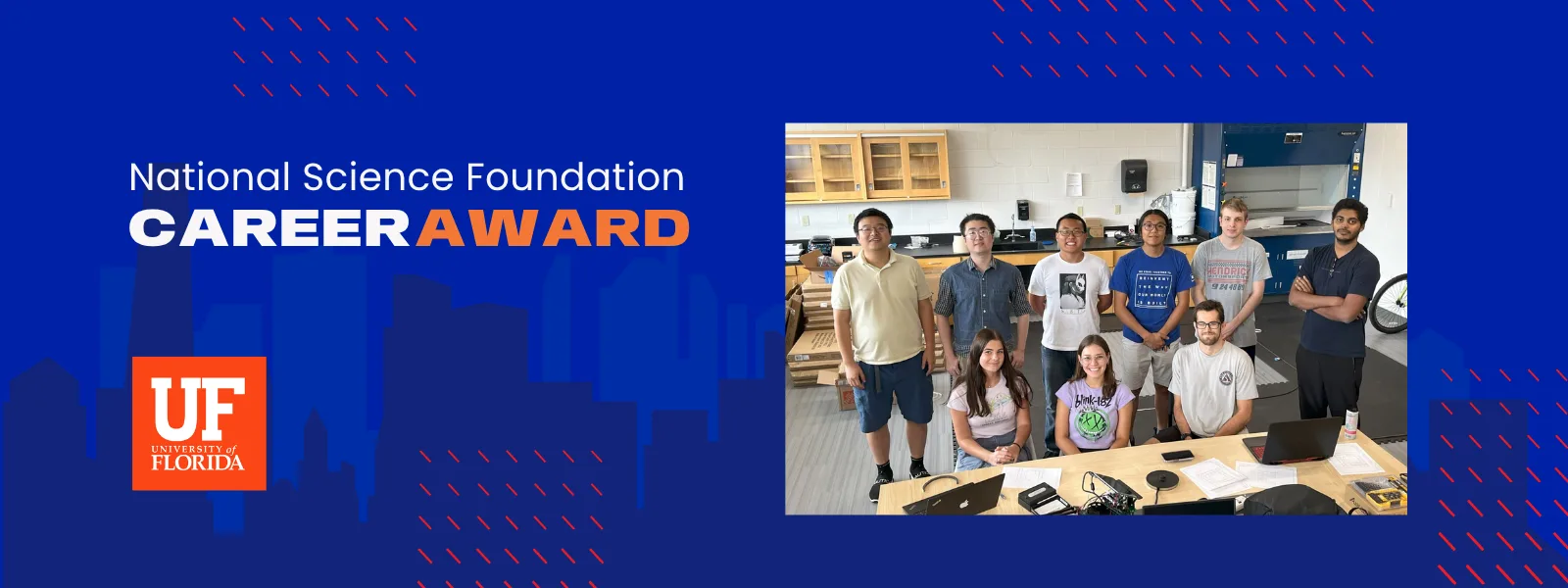
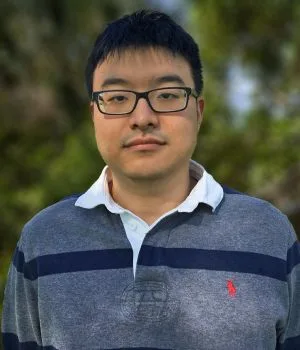
For Yu Wang, Ph.D., engineering has always been about more than technology. It’s about people.
Long before receiving one of the nation’s most prestigious honors for early-career faculty, the National Science Foundation CAREER Award, Wang was fascinated by a simple question: How can we teach autonomous systems to be safer, more reliable, and more beneficial to society?
The question has guided his career and now serves as the foundation of his award-winning research at the University of Florida.
The NSF CAREER Award recognizes faculty members who demonstrate exceptional potential as both researchers and educators. For Wang, the award represents not only praise for years of work but also an opportunity to pursue a long-term vision for the future of artificial intelligence, robotics, and autonomous systems.
“I see it not only as recognition of past work, but also as a responsibility,” Wang explains, “to advance the field, to build a strong research program, and to carry forward the mentorship I have received by supporting students and junior researchers in their own journeys.”
Wang’s path has been shaped by mentors, collaborators, students, and family members who encouraged him along the way. Wang speaks with gratitude about the professors who guided his development, the students whose creativity drives discovery, and his wife Jingjing, whose support has been constant throughout his career.
Today, Wang’s research focuses on one of the most important challenges facing modern technology and how to make autonomous systems both intelligent and trustworthy.
Wang says, “The next generation of autonomous systems, such as robotaxis, service robots, and delivery drones, will need to operate safely around people while adapting to individual needs.” Wang continues by stating that, “Today, these systems often follow rules that engineers write in advance. But ordinary users usually do not express their preferences as formal rules.”
Wang’s research questions if autonomous systems can learn from this kind of simple human feedback while still operating safely. The answer to this could transform how people interact with technology.
His CAREER project includes artificial intelligence and control methods that will help machines understand people. This work aims to help future machines and technologies understand human preferences without sacrificing privacy and security.
This problem becomes increasingly urgent as AI systems take on greater responsibility in transportation, infrastructure, and many more physical world environments.
“When AI controls physical systems, mistakes can have real-world consequences,” Wang says.
For Wang, preparing future generations of engineers is just as important as advancing technology itself. Looking ahead, he envisions a world where autonomous systems can safely adapt to individual users and communities. Most importantly, he hopes the engineers who build those systems will do so with safety, trust, and human needs at the center of their designs.
Through research, education, and collaboration, Yu Wang is helping shape a future where artificial intelligence works not just intelligently but responsibly.
Story & Editing by: Emma Baker
Marketing & Communications Assistant
UF Mechanical & Aerospace Engineering
June 4, 2026